
Gold in Medicine
The precious Metal with a connection to the Heart
How Gold Can Support with Stress and Exhaustion
For millennia, gold has captivated humanity with its unparalleled brilliance and symbolic power. It is not only the most well-known precious metal but also a symbol of purity, consistency, and value. However, the qualities of gold extend far beyond its role as jewelry or an investment – in Anthroposophic Medicine, gold is valued as an effective remedy for exhaustion, anxiety, restlessness, and stress. It has a balancing effect on the body, mind, and soul, stabilizing individuals at their core. This is rooted in its connection to the sun and the heart, which emphasizes the harmonizing and strengthening nature of gold.
Gold – A Treasure from the Depths of the Universe
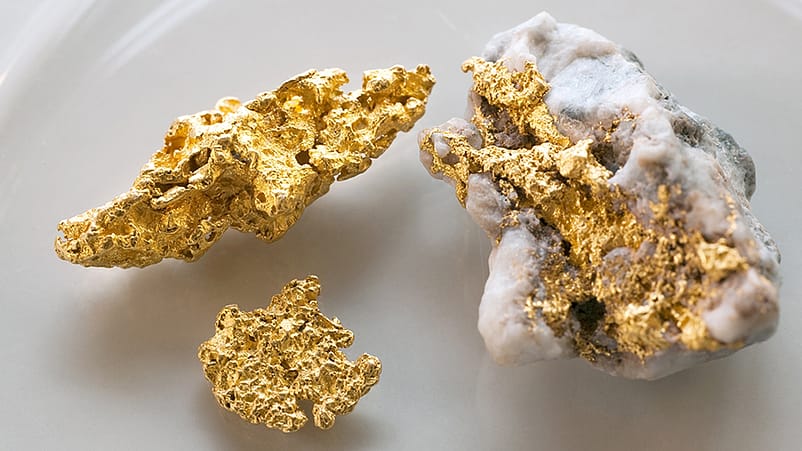
Gold impresses not only because of its symbolic power and medicinal effects but also due to its origin and unique qualities. But where does gold actually come from? The precious metal was formed billions of years ago during massive cosmic events such as supernova explosions and reached Earth through meteorites. Although gold is found worldwide, the raw material is present in the Earth's crust only in minimal quantities. The concentration is about 0.004 ppm – meaning that out of a billion parts of the Earth's crust, only about 4 parts are gold.
Its rarity and properties make it one of the most valuable metals: The golden-yellow color, reminiscent of the sun's radiance, along with its physical and chemical characteristics, make it unique. It exudes an unparalleled brilliance, is chemically stable, and can endure for centuries.


What Makes Gold So Unique?
Gold is a precious metal that is typically found in nature in its pure, metallic form. It is extremely resistant to chemical reactions and rarely bonds with other elements. Even in laboratory conditions, it shows little tendency to react with non-metals – it is only soluble in a specific mixture of hydrochloric acid and nitric acid (known as "aqua regia"). Physically, gold impresses with its extraordinary malleability. It is so ductile that just one gram of gold can be drawn into a wire approximately two kilometers long. Similarly, it can be hammered into ultra-thin gold leaf, which allows light to pass through and displays fascinating color effects ranging from yellow to green or bluish-gray.
With a density of 19.3 g/cm³, gold is one of the heaviest metals, even heavier than lead, which has a density of 11.3 g/cm³. This property, combined with its chemical stability, makes it a "permanent resident of the Earth" – unlike many other metals, such as iron, which readily reacts with other elements and quickly rusts.
Symbol of Power, Wealth, and Eternity
Since ancient times, gold has been valued for its unique properties and has been a sought-after material in the creation of jewelry and art. As a symbol of power, wealth, and eternity, it has played a central role throughout history – from the magnificent crowns and scepters of kings, which emphasized their rule and authority, to coins that served as the first currency and revolutionized trade. Cultures around the world, from the ancient Egyptians to the Incas, revered gold as a divine material associated with light and immortality. Even today, gold remains a symbol of security and value, whether as an investment, an expression of beauty and permanence, or as a representation of success and prosperity.
Gold in Anthroposophic Medicine
In anthroposophic understanding, gold is closely associated with the human heart and the circulatory system. The heart is the center of the circulatory system, where blood is sent to the periphery and then returns – a constant rhythm of contraction and expansion, reminiscent of the qualities of gold.
The astronomical symbol of gold, a dot within a circle, reflects this dynamic: it represents the balance between rest and movement, between center and periphery. This balancing property of gold is utilized in Anthroposophic Medicine to strengthen a person's core and bring body, mind, and soul into harmony.
The Processing of Gold: From Metal to Remedy
To harness the unique properties of metals for the production of medicines, specific processes are required depending on the area of application. Three of these processes are particularly noteworthy and are, in part, exclusively used in Anthroposophic Medicine.
Metal Mirror Distillation
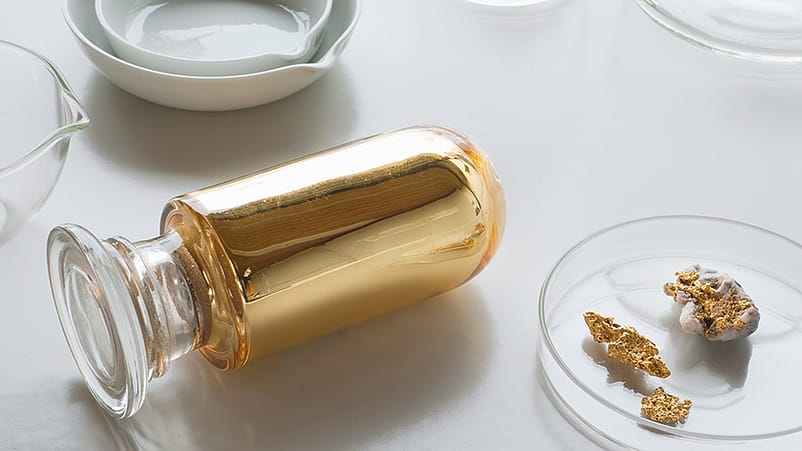
In this process, the metal, such as gold, is heated to extremely high temperatures in a specialized distillation apparatus: gold melts at 1063°C and evaporates in a vacuum at approximately 1400°C. Through the evaporation process, the metal restructures itself and appears as an ultra-thin, shiny layer – the so-called metal mirror. For the metal, this process represents a renewal and "rejuvenation," echoing its own creation story.
The resulting metal mirror is then carefully scraped off. The gold mirror is an especially refined form of the metal, making it ideal for further processing into medicines. This method, exclusively used by Weleda, is absolutely unique in pharmaceutical production.
Reductive Metal Mirror and Colloidal Gold
In addition to distillation, noble metals like silver and copper produce metal mirrors through the reduction of their salts in aqueous solutions under heat. Another method involves the production of colloidal gold. In this process, gold ions are reduced in an aqueous solution. The resulting gold particles are so tiny that they remain suspended in the liquid without settling.
During this process, a fascinating play of colors emerges, ranging from yellow to pink to vermilion red. These colors symbolize gold's connection to light and warmth and its ability to create balance between opposing forces. In the production of reductive metal mirrors, gold undergoes similar processes, where it is dissolved, reduced, and finally scraped off. The reductive metal mirrors of gold, silver, and copper are used in the production of ointments.
Vegetabilization
Vegetabilization is a unique process in Anthroposophic Medicine, where metals like gold are "brought to life" through the life processes of medicinal plants. Medicinal plants are cultivated in soil enriched with potentized metal preparations, allowing the metal to acquire a dynamic quality and integrate with the plant's essence. Once the plant reaches full bloom, its flowers and leaves are harvested and turned into compost for the following year.
This process is repeated twice, meaning the medicinal plants enliven the metal over a total of three vegetation cycles. After the third vegetation period, the plants are harvested to create tinctures for medicines. This process combines the stability of the metal with the vitality of the plant, forming the foundation for holistic remedies.

Gold – A Remedy with Heart
The connection of gold to the sun and the heart is reflected in its balancing and harmonizing effects. It strengthens the inner core and promotes balance between body, mind, and soul. Through the meticulous processes of metal mirror production and vegetabilization, gold is transformed into a form that optimally unfolds its healing properties. In this way, the radiant precious metal becomes a valuable remedy that can holistically support individuals dealing with exhaustion, anxiety, restlessness, and stress.
